
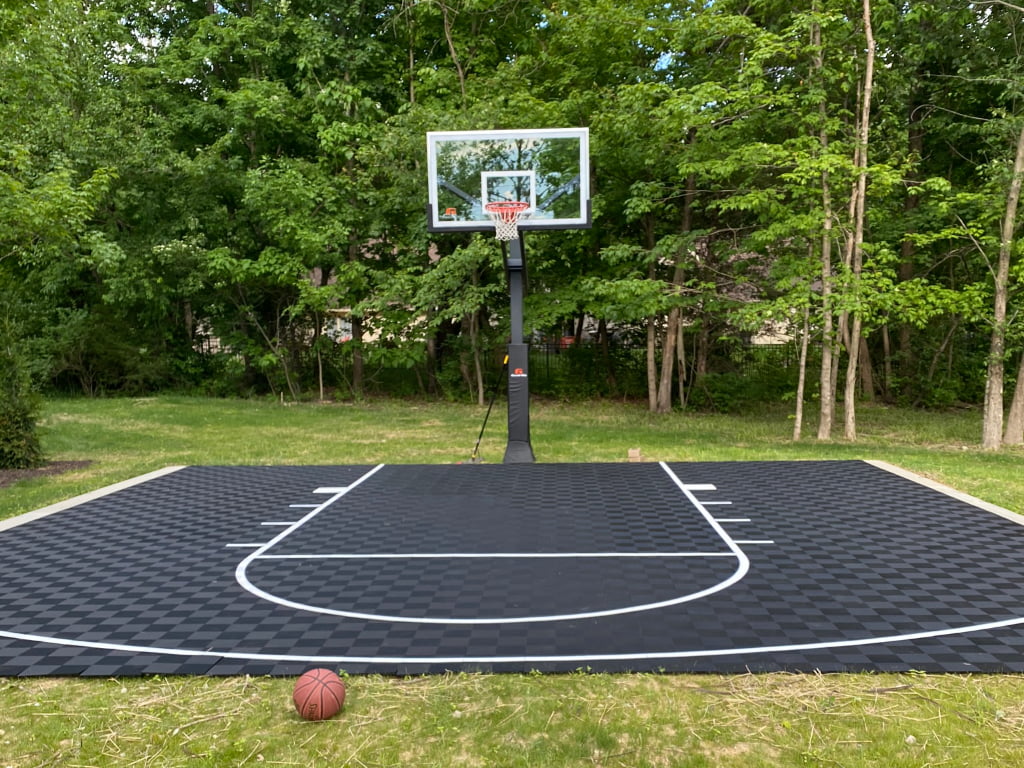
Image Source: modutile.com
How Much Does A Half Basketball Court Cost: Your Budget Guide
A half basketball court can range from a few hundred dollars for a simple DIY setup to over $20,000 for a professional, custom installation. The half court basketball installation cost is influenced by many factors, including the size of the court, the type of surfacing, the quality of equipment, and whether you opt for a DIY approach or professional help.
Getting Started: What to Consider Before Buying
Before you start looking at prices, it’s important to think about what you want in a half basketball court. This will help you get a clearer picture of the backyard basketball court pricing.
Factors Influencing Your Half Court Budget
Several key elements will determine the overall half basketball court construction expenses. Let’s break them down:
- Size of the Court: While it’s a “half” court, there’s still variation. A standard half court is typically 42 feet long by 30 feet wide. However, you might have space for a slightly smaller or larger area. The larger the court, the more materials and labor will be needed.
- Court Surfacing: This is a big cost driver. Options range from simple concrete or asphalt to specialized sport court tiles or even high-quality acrylic coatings. Each has its own price tag and benefits.
- Basketball Hoop and Backboard: The quality and type of hoop you choose can significantly impact the total cost. From basic in-ground systems to adjustable, professional-grade hoops, there’s a wide spectrum.
- Labor and Installation: Will you be doing the work yourself, or will you hire professionals? Professional installation adds to the half court basketball installation cost but ensures a quality build.
- Site Preparation: Your existing yard might need grading, excavation, or drainage work, which can add to the expenses.
- Accessories and Extras: Things like lighting, fencing, benches, or custom line painting can increase the overall price.
Decoding the Costs: Breakdown of Expenses
Let’s dive deeper into the specific costs associated with building a half basketball court.
Court Surfacing Options and Their Prices
The surface of your court is crucial for playability and safety. Here’s a look at common options and their associated half court basketball surfacing cost:
Concrete:
- Pros: Durable, long-lasting, relatively low maintenance.
- Cons: Can crack over time if not installed properly, hard surface can be tough on joints, requires professional installation for best results.
- Estimated Cost: $4-$8 per square foot. For a standard half court (1,260 sq ft), this could range from $5,040 to $10,080. This cost typically includes basic site preparation and finishing.
Asphalt:
- Pros: Good durability, more flexible than concrete (less prone to cracking), can be sealed to improve longevity.
- Cons: Needs regular sealing, can be affected by extreme temperatures, requires professional installation.
- Estimated Cost: $3-$6 per square foot. For a standard half court, this could be $3,780 to $7,560.
Sport Court Tiles (Modular Systems):
- Pros: Excellent drainage, superior shock absorption, available in various colors, easy to install, can be a great DIY half basketball court cost saver if you’re handy.
- Cons: Can be more expensive upfront than concrete or asphalt, may require a level base like concrete or compacted gravel.
- Estimated Cost: $4-$10 per square foot. For a standard half court, this could range from $5,040 to $12,600. The half court basketball surfacing cost here can vary greatly based on tile quality and brand.
Acrylic Coating (Over Concrete or Asphalt):
- Pros: Provides a smooth, vibrant playing surface, offers good traction, can be customized with different colors and lines.
- Cons: Requires a solid base (concrete or asphalt), needs periodic recoating.
- Estimated Cost: $2-$5 per square foot for the coating itself. Applied over a concrete base, the total cost for a half court could be $7,000 to $15,000+.
Basketball Hoop and Equipment Costs
The half court basketball equipment cost can also vary significantly.
In-Ground Hoop Systems:
- Entry-Level: $300 – $800. These are typically smaller backboards and lighter poles, suitable for casual play.
- Mid-Range: $800 – $2,000. Better backboard materials (acrylic or tempered glass), thicker poles, and adjustable height.
- Professional-Grade: $2,000 – $5,000+. Large, regulation-size tempered glass backboards, heavy-duty poles, and breakaway rims.
Adjustable vs. Fixed Height: Adjustable hoops offer versatility, especially for younger players, but can be more complex and costly. Fixed height hoops are simpler and often more affordable.
Portable Basketball Hoops:
- Pros: Can be moved, no permanent installation required.
- Cons: Less stable than in-ground systems, often smaller backboards, can be less durable.
- Portable half basketball court cost: Generally ranges from $200 to $1,000. These are best for very casual play and may not provide a true half-court experience.
Backboard Materials:
- Acrylic: Affordable, good bounce, but can scratch.
- Polycarbonate: Durable, good rebound, but can yellow over time.
- Tempered Glass: Best rebound and durability, most expensive, requires sturdy pole and anchor.
Rim:
- Basic: $50 – $150.
- Breakaway Rim: $150 – $400+. Essential for dunking and preventing rim damage.
Other Equipment:
- Basketballs: $20 – $60
- Line Paint/Tape: $50 – $200 (for DIY line marking)
Professional Installation vs. DIY
This is a critical decision that heavily impacts professional half basketball court installation pricing.
Professional Installation:
- Pros: Expertise in site preparation, concrete pouring, surfacing application, and hoop installation; ensures a high-quality, durable court; saves you time and physical labor.
- Cons: Significantly higher overall cost.
- Cost: Expect to pay an additional $5,000 – $10,000+ for professional labor, depending on the complexity of the job and your location. This adds to the total residential basketball court pricing.
DIY Installation:
- Pros: Substantial cost savings, rewarding personal achievement.
- Cons: Requires significant time, effort, and the right tools; potential for errors if inexperienced, which can lead to costly repairs; might not achieve the same professional finish.
- DIY half basketball court cost: While you save on labor, you’ll still incur costs for materials, equipment rental (if needed), and potentially mistakes. The savings could be anywhere from 30% to 50% of the total project cost, but this requires careful planning and execution.
Site Preparation and Additional Costs
Don’t forget the costs that go into getting your yard ready.
- Grading and Excavation: If your yard isn’t level, you’ll need to grade it. This can cost $500 – $3,000 depending on the amount of earth moved and the complexity.
- Drainage: Proper drainage is vital to prevent water damage and cracking. French drains or grading for runoff can add $500 – $2,000.
- Permits: Some local municipalities require permits for construction projects, which can cost $50 – $300.
- Fencing: If you want to keep balls contained, fencing around the court can add $1,000 – $5,000+.
- Lighting: For evening play, floodlights can cost $500 – $2,000 for installation.
Putting It All Together: Sample Cost Estimates
Let’s look at some realistic scenarios for a standard half basketball court (42 ft x 30 ft = 1,260 sq ft).
Budget-Friendly DIY Half Court
- Surface: Basic asphalt or a DIY-friendly sport tile system.
- Hoop: Mid-range in-ground adjustable hoop.
- Labor: DIY.
- Site Prep: Minimal, assume a relatively level yard.
| Item | Estimated Cost Range |
|---|---|
| Asphalt/Tiles | $4,000 – $7,000 |
| Hoop System | $800 – $1,500 |
| Line Marking (DIY) | $100 – $200 |
| Total Estimate | $4,900 – $8,700 |
Mid-Range Professional Half Court
- Surface: High-quality concrete with acrylic coating.
- Hoop: Good quality in-ground adjustable hoop with tempered glass backboard.
- Labor: Professional installation.
- Site Prep: Minor grading and drainage.
| Item | Estimated Cost Range |
|---|---|
| Concrete Base | $6,000 – $9,000 |
| Acrylic Coating | $2,500 – $5,000 |
| Hoop System | $1,500 – $3,000 |
| Site Prep | $1,000 – $3,000 |
| Professional Labor | $5,000 – $8,000 |
| Total Estimate | $16,000 – $28,000 |
Premium Custom Half Court
- Surface: Premium sport court tiles or specially engineered concrete with high-end acrylic.
- Hoop: Professional-grade in-ground hoop with superior backboard and rim.
- Labor: Professional installation.
- Site Prep: Extensive grading, drainage, potential retaining walls.
- Extras: Lighting, custom line painting, fencing.
| Item | Estimated Cost Range |
|---|---|
| Premium Surfacing | $8,000 – $15,000 |
| Pro-Grade Hoop | $3,000 – $5,000 |
| Site Prep/Grading | $2,000 – $5,000 |
| Professional Labor | $8,000 – $12,000 |
| Lighting/Fencing | $2,000 – $7,000 |
| Custom Line Painting | $300 – $800 |
| Total Estimate | $23,300 – $44,800 |
Portable Half Basketball Court Costs
If you’re looking for a less permanent solution, a portable half basketball court cost is significantly lower. These typically involve a portable hoop unit.
- Basic Portable Hoops: $200 – $500. These have smaller backboards and are meant for very casual play.
- Mid-Range Portable Hoops: $500 – $1,000. Offer larger backboards and more stable bases, often with adjustable height.
- High-End Portable Hoops: $1,000 – $2,000+. More robust construction, better backboard materials, and greater stability.
It’s important to note that while these offer lower initial costs, they don’t provide the dedicated playing surface of a built court. The backyard basketball court pricing for a portable unit is fundamentally different from a built court.
Custom Half Basketball Court Pricing
When you want something unique, custom half basketball court pricing comes into play. This can include:
- Unique Shapes or Sizes: Deviating from the standard half court dimensions.
- Specialty Surfacing: Such as cushioned surfaces or specific colored patterns.
- Integrated Features: Like built-in seating or decorative elements.
- High-End Branding or Logos: Incorporated into the court design.
The cost for custom work is highly variable and depends on the specific requests. It will almost always be at the higher end of the spectrum, potentially exceeding $30,000-$40,000 for elaborate designs.
Maximizing Your Investment: Tips for Saving Money
Even with a budget in mind, there are ways to keep costs down.
Smart Savings Strategies
- Shop Around for Materials: Compare prices from different suppliers for concrete, asphalt, tiles, and hoops.
- Timing is Key: Consider building during the off-season (fall or winter) when contractors might offer lower rates.
- DIY Where Possible: If you’re handy, tackling tasks like site prep, line painting, or even tile installation can save a lot on labor. This is where the DIY half basketball court cost savings are most significant.
- Start Simple: You can always upgrade equipment or add features later. Begin with a solid base and a decent hoop.
- Consider Used Equipment: While not ideal for high-performance play, sometimes you can find used hoops or surfacing materials in good condition.
Long-Term Value and Maintenance
Investing in quality materials and proper installation upfront will save you money on repairs and replacements down the line. Regular maintenance, such as cleaning and sealing surfaces, will prolong the life of your court.
Frequently Asked Questions (FAQs)
- Q: How long does a half basketball court last?
A: A well-built and maintained half basketball court, especially with a concrete base and good surfacing, can last 20-30 years or even longer. - Q: Do I need a permit to build a half basketball court?
A: It depends on your local zoning laws and building codes. It’s best to check with your local municipality before starting any construction. - Q: Is a concrete or asphalt surface better for a half basketball court?
A: Both are good options. Concrete is generally more durable but can crack. Asphalt is more flexible but requires more sealing. Sport court tiles offer superior shock absorption and drainage. - Q: Can I build a half basketball court on grass?
A: No, you cannot build a proper basketball court directly on grass. The surface needs to be firm, level, and stable. You would need to excavate and install a base like compacted gravel, concrete, or asphalt. - Q: What’s the difference in cost between a full and a half court?
A: Roughly, a full court will cost about double a half court, as you’re essentially doubling the surfacing area, though some economies of scale might apply.
Building a half basketball court is a significant investment, but with careful planning and budgeting, you can create a fantastic recreational space that provides years of enjoyment. From the initial half court basketball installation cost to the ongoing backyard basketball court pricing considerations, this guide should help you make informed decisions for your perfect court.