
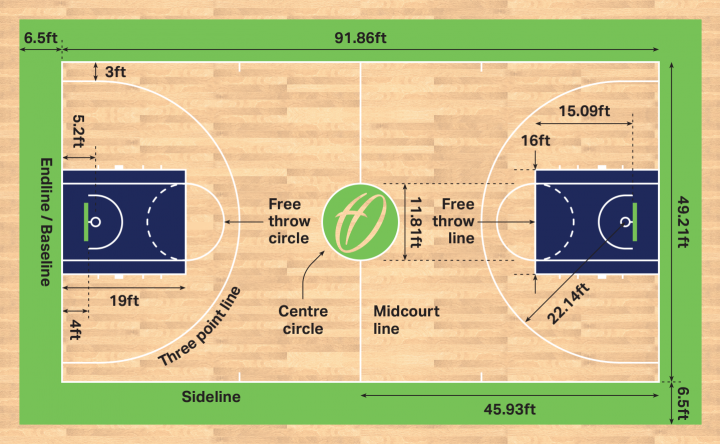
Image Source: www.harrodsport.com
How Long Is a Basketball Court? NBA, FIBA, NCAA & More Compared
A regulation basketball court is 94 feet long and 50 feet wide in the NBA and NCAA, while FIBA courts are slightly shorter at 28 meters (91.86 feet) long and 15 meters (49.21 feet) wide. The standard basketball hoop height remains constant across most leagues at 10 feet from the floor.
Basketball, a sport known for its dynamic pace and strategic plays, relies heavily on the dimensions of its playing surface. The size of the court directly impacts gameplay, from offensive spacing and defensive strategies to shooting angles and player fatigue. While the core concept of a rectangular court with hoops at each end remains consistent, the specific NBA court dimensions, FIBA court size, and NCAA basketball court length can vary, leading to subtle yet significant differences in how the game is played. This exploration delves into the intricacies of these dimensions, comparing them and touching upon other relevant aspects like high school basketball court measurements and the impact of different court types.
Deciphering the Dimensions: A Global Look
The world of basketball features several governing bodies, each with its own set of rules and court specifications. The most prominent of these are the National Basketball Association (NBA) in North America, the International Basketball Federation (FIBA) for international play, and the National Collegiate Athletic Association (NCAA) in the United States for college athletics.
NBA Court Dimensions: The Pinnacle of Professional Play
The NBA has established a specific set of dimensions for its courts, designed to accommodate the league’s fast-paced and high-scoring style of play.
- Length: An NBA court measures exactly 94 feet from baseline to baseline.
- Width: The width of an NBA court is 50 feet.
These dimensions have remained largely consistent for decades, providing a familiar and predictable playing environment for the world’s top basketball players. The ample space allows for greater offensive freedom, enabling players to drive to the basket, execute intricate passing plays, and utilize the three-point line effectively.
FIBA Court Size: The International Standard
FIBA, the international governing body for basketball, sets the standards for courts used in the Olympics, World Cups, and other international competitions. Their dimensions differ slightly from the NBA.
- Length: A FIBA court measures 28 meters (approximately 91.86 feet) in length.
- Width: The width of a FIBA court is 15 meters (approximately 49.21 feet).
The shorter length and slightly narrower width of a FIBA court can lead to a more condensed style of play. Defenses can often press more effectively, and the game can feel more physical due to less open space. Many international players who transition to the NBA need to adjust to the larger court size.
NCAA Basketball Court Length: College Hoops Standards
In the United States, the NCAA oversees college basketball. Their court dimensions are generally aligned with the NBA, providing a consistent experience for student-athletes.
- Length: An NCAA basketball court is also 94 feet long.
- Width: The width of an NCAA basketball court is 50 feet.
This uniformity between NBA and NCAA court sizes is crucial for player development. College players aiming for professional careers can hone their skills on a court that mirrors the NBA environment, making the transition smoother.
High School Basketball Court: Laying the Foundation
While professional and collegiate levels adhere to specific standards, high school basketball court dimensions can sometimes vary, especially in older facilities. However, the general trend is to follow a standard that prepares players for higher levels.
- Typical Length: Most high school courts aim for 94 feet in length.
- Typical Width: Most high school courts aim for 50 feet in width.
However, it’s not uncommon to find high school gyms with courts that are slightly shorter or narrower due to space constraints or older construction. These variations can impact offensive strategies and defensive intensity, but the fundamental skills of the game remain the same. For official state championships or nationally recognized tournaments, adherence to standardized dimensions is usually enforced.
Other Court Variations and Considerations
Beyond the major leagues, there are other factors that can influence court dimensions or perceptions of court size.
Indoor vs. Outdoor Courts
The distinction between an indoor basketball court and an outdoor basketball court is primarily about the surface and environmental factors. While the official basketball court length and width are intended to be the same regardless of location, outdoor courts can be affected by weather, wear and tear, and sometimes less precise construction.
- Indoor Courts: Typically made of hardwood, providing a consistent bounce and grip. The controlled environment allows for precise basketball court markings and a predictable playing surface.
- Outdoor Courts: Often made of asphalt or concrete. While durable, these surfaces can be less forgiving and their condition can vary greatly. The length and width might also be less standardized in casual outdoor settings.
Tennis Court Size Comparison: A Different Arena
It’s interesting to compare the dimensions of a basketball court to other popular sports. A tennis court size comparison highlights the differences in the space required for each sport.
- Tennis Court (Singles): 78 feet long and 27 feet wide.
- Tennis Court (Doubles): 78 feet long and 36 feet wide.
As you can see, even the doubles tennis court, which is wider, is significantly shorter and narrower than a basketball court. This underscores the vast amount of running and lateral movement required in basketball, as well as the importance of court positioning for shooting and defense. The sheer expanse of a basketball court allows for more aerial play and faster transitions between offense and defense.
Examining the Basketball Court Markings: The Blueprint of Play
Beyond the overall length and width, the intricate basketball court markings play a vital role in structuring the game. These lines dictate boundaries, shooting zones, and strategic areas of the court.
Key Markings and Their Significance
- Sidelines and Baselines: These lines define the outer boundaries of the playing area. If the ball or a player with the ball touches these lines, it is considered out of bounds.
- Center Circle: Located at the center of the court, this circle is used for the opening tip-off at the start of the game and any subsequent jump balls.
- Free Throw Line: This line is positioned 15 feet from the front of the backboard. Players shoot free throws from behind this line.
- Three-Point Line: This arc designates shots that are worth three points. Its distance from the basket varies between leagues.
- NBA Three-Point Line: 23 feet 9 inches at the top of the arc and 22 feet in the corners.
- FIBA Three-Point Line: 6.75 meters (approximately 22.15 feet) from the center of the basket.
- NCAA Three-Point Line: 22 feet 1.75 inches at the top of the arc and 21 feet 3 inches in the corners.
The differing lengths of the three-point line can influence shooting strategies, with longer lines potentially encouraging more mid-range shots or requiring greater shooting range.
- The Paint (Key or Lane): This rectangular area extends from the baseline under the basket to the free-throw line. It’s often referred to as the “three-second area” for offensive players.
- Restricted Area Arc: Under the basket, there is a semi-circular arc. Defenders cannot establish a position within this arc to draw offensive fouls when the offensive player is in the air.
The Constant: Standard Basketball Hoop Height
Regardless of the court’s length or width, the standard basketball hoop height remains a universal constant in professional and collegiate basketball.
- Hoop Height: The rim of the basketball hoop is positioned 10 feet (3.05 meters) above the court surface.
This consistent height ensures that the challenge of shooting, rebounding, and dunking remains the same across different leagues and levels of play. It’s a fundamental element that defines the physical challenge of the sport.
Why Do Dimensions Matter? Impact on Gameplay
The seemingly minor differences in court dimensions can have a significant impact on the game’s flow, strategies, and player performance.
Spacing and Pace
- Wider/Longer Courts (NBA/NCAA): The extra space on NBA and NCAA courts allows for better spacing between players. This can lead to more isolation plays, greater opportunities for drives to the basket, and more open shots. The larger court also facilitates faster transitions from defense to offense, as players have more room to run.
- Shorter/Narrower Courts (FIBA): The more confined space on FIBA courts can lead to a more physical game. Defenses can more easily collapse on offensive players, making it harder to penetrate. Passing lanes can be more congested, and the game can feel more like a half-court battle.
Shooting and Strategy
- Three-Point Line: The varying distances of the three-point line can influence offensive sets. On a longer line, players might be less inclined to shoot from extreme ranges, focusing more on getting closer to the basket. Conversely, a shorter line can open up the court and encourage more long-range attempts.
- Rebounding: The overall size of the court can also affect rebounding battles. On larger courts, offensive rebounds might be harder to secure due to the greater area to cover.
Player Performance and Fatigue
- Endurance: Playing on a larger court requires more running and stamina. Players in the NBA and NCAA need to maintain a higher level of conditioning to cope with the demands of the 94-foot length.
- Defensive Footwork: The extra space in the NBA and NCAA also demands superior defensive footwork and awareness to cover more ground and contest shots effectively.
Frequently Asked Questions (FAQ)
Q1: What is the difference between an NBA court and a FIBA court?
A1: An NBA court is 94 feet long and 50 feet wide, while a FIBA court is 28 meters (approximately 91.86 feet) long and 15 meters (approximately 49.21 feet) wide. The NBA court is slightly longer and wider.
Q2: Are NCAA basketball courts the same size as NBA courts?
A2: Yes, NCAA basketball courts are the same size as NBA courts, measuring 94 feet long and 50 feet wide.
Q3: Is the basketball hoop height the same everywhere?
A3: The standard basketball hoop height is 10 feet from the floor for most organized basketball, including NBA, FIBA, and NCAA. However, lower heights are used for youth leagues.
Q4: Can you play basketball on a tennis court?
A4: While you can technically shoot hoops or practice dribbling on a tennis court, its dimensions (78 feet long by 27-36 feet wide) are significantly smaller than a regulation basketball court, making it unsuitable for a full game.
Q5: What are the dimensions of a high school basketball court?
A5: Most high school basketball courts aim to match the NBA and NCAA dimensions of 94 feet by 50 feet. However, some older or smaller facilities might have slightly different measurements.
Q6: How do basketball court markings affect the game?
A6: Basketball court markings, such as the three-point line, free-throw line, and the paint, define shooting zones, strategic areas, and foul shot locations, directly influencing offensive and defensive strategies.
Q7: Does the court surface matter?
A7: Yes, the court surface, typically hardwood for indoor courts and asphalt or concrete for outdoor courts, affects ball bounce, player traction, and overall playability. Indoor courts generally offer more consistent performance.
By comprehending these varying dimensions and markings, fans and players alike can gain a deeper appreciation for the nuances of basketball, from the precise lines on the floor to the global standards that govern this beloved sport. Whether it’s the expansive hardwood of an NBA arena or a community court under the open sky, the essence of basketball is played within these defined boundaries.