
A mile on a standard NBA basketball court is equivalent to approximately 15.5 laps. This calculation depends on the specific dimensions of the court being used, but for most regulation courts, this is the general answer.
So, you’re looking to convert your basketball court sprints into a measurable mile? That’s a fantastic way to add variety and intensity to your exercise routine! Running a mile on a basketball court might seem straightforward, but there are a few factors to consider to get an accurate picture of your distance. Let’s break down how far is a mile and how it translates to the familiar lines of a basketball court.
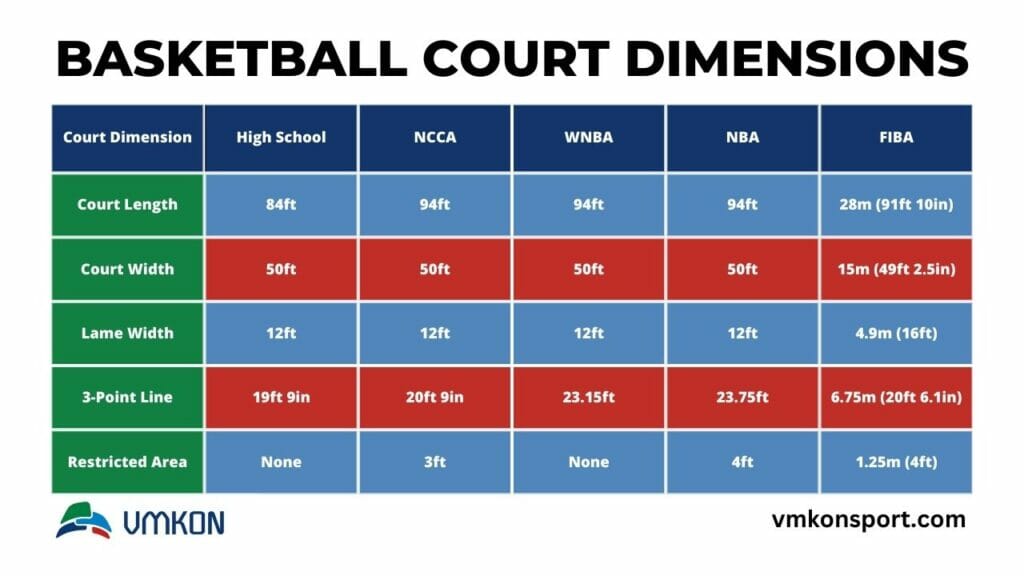
Image Source: vmkonsport.com
Deciphering Basketball Court Dimensions
Before we can calculate how many laps make a mile, we need to establish the basketball court length and overall basketball court dimensions. These measurements can vary slightly depending on the league or governing body, but we’ll focus on the most common standards.
NBA Court Specifications
- Overall Length: 94 feet (28.7 meters)
- Overall Width: 50 feet (15.2 meters)
- Key (Free Throw Lane): 19 feet long (5.8 meters) by 16 feet wide (4.9 meters) at the foul line.
- Three-Point Line: 23 feet 9 inches (7.24 meters) from the center of the hoop on the sidelines and arc.
NCAA (College) and FIBA (International) Courts
While NBA courts are the most widely recognized, other leagues have slightly different dimensions:
- NCAA Courts: Similar to NBA, typically 94 feet long by 50 feet wide.
- FIBA Courts: Slightly shorter and narrower, measuring 28 meters (91.86 feet) long by 15 meters (49.21 feet) wide. The three-point line is also closer, at 6.75 meters (22.15 feet).
For the purpose of our mile calculation, we’ll primarily use the standard NBA basketball court dimensions as it’s the most common reference point for many.
Calculating the Basketball Court Perimeter
When you’re running a mile on a basketball court, you’re essentially covering the basketball court perimeter multiple times. Let’s figure out the length of one full lap around the outside of the court.
To calculate the perimeter, we add up the lengths of all four sides:
Perimeter = (Length + Width) × 2
Using NBA dimensions:
Perimeter = (94 feet + 50 feet) × 2
Perimeter = 144 feet × 2
Perimeter = 288 feet
So, one full lap around the outside of a standard NBA basketball court is 288 feet.
How Far Is a Mile in Feet?
We know that a mile is a common unit of distance, but what does it measure up to in feet?
1 mile = 5,280 feet
This is a crucial piece of information for our calculation.
Converting Feet to Laps: The Core Calculation
Now we have all the pieces to answer our main question: How many laps around the basketball court is a mile?
We need to divide the total distance of a mile by the distance of one lap around the court.
Number of Laps = Total Distance (in feet) / Distance per Lap (in feet)
Using our NBA court perimeter:
Number of Laps = 5,280 feet / 288 feet per lap
Let’s do the math:
5280 / 288 = 18.33 laps
Wait a minute! This assumes you’re running the absolute outer edge of the court, which isn’t typically how people think of “laps” on a court. When people talk about running laps on a basketball court, they usually mean running from baseline to baseline, or baseline to half-court, etc. This is where the concept of measuring distance basketball court becomes more nuanced.
Rethinking the “Lap” on a Basketball Court
The term “lap” in the context of running a mile on basketball court can be interpreted in a few ways. Let’s explore the most common interpretations and how they affect the number of laps.
Interpretation 1: Baseline to Baseline (Length)
Many people consider a “lap” to be running the length of the court from one baseline to the other.
- Basketball court length: 94 feet
If a “lap” is just running the length:
Number of Laps = 5,280 feet / 94 feet per lap
Number of Laps = 56.17 laps
This means running from baseline to baseline and back would be one lap.
- One baseline to baseline = 94 feet
- Baseline to baseline and back = 94 feet × 2 = 188 feet
So, if a “lap” is a round trip of the court’s length:
Number of Laps = 5,280 feet / 188 feet per lap
Number of Laps = 28.08 laps
This is a much more common way to think about “laps” in a basketball context.
Interpretation 2: Along the Sidelines and Baselines (Perimeter)
As calculated earlier, if a “lap” means running the entire basketball court perimeter:
- Basketball court perimeter: 288 feet
Number of Laps = 5,280 feet / 288 feet per lap
Number of Laps = 18.33 laps
This is less common for quick sprints, but could be how someone structures a longer endurance run.
Interpretation 3: Running the “Lane” or Half-Court
Sometimes, shorter bursts or drills involve running specific distances on the court, like the width of the lane or from baseline to the free-throw line. However, these are typically not referred to as “laps” in the context of measuring a mile.
The Most Practical “Lap” for Mile Calculation
When discussing how many laps around the basketball court is a mile, the most sensible interpretation for exercise purposes is running from one baseline to the opposite baseline and back. This simulates a continuous running path within the court’s boundaries.
Let’s re-examine this with our NBA dimensions:
- Basketball court length: 94 feet
- One full length (baseline to baseline): 94 feet
- One round trip (baseline to baseline and back): 94 feet + 94 feet = 188 feet
Now, to find out how many of these round trips make a mile:
Number of Laps = 5,280 feet / 188 feet per lap
Number of Laps = 28.085 laps
Therefore, approximately 28 laps (baseline to baseline and back) will get you very close to a mile on a standard NBA basketball court.
Factoring in FIBA Court Dimensions
Let’s see how the slightly smaller FIBA court affects the number of laps.
- FIBA Court Length: 28 meters
- Convert to feet: 28 meters × 3.28084 feet/meter = 91.86 feet
If a “lap” is a round trip of the FIBA court’s length:
- One round trip: 91.86 feet × 2 = 183.72 feet
Now, calculate the number of laps for a mile:
Number of Laps = 5,280 feet / 183.72 feet per lap
Number of Laps = 28.74 laps
So, on a FIBA court, you’d need about 28.75 laps (baseline to baseline and back) to run a mile. This is slightly more than on an NBA court due to the shorter length.
Why Use a Basketball Court for Exercise?
Using a basketball court for your exercise basketball court routine offers several advantages:
Consistent Surface
Basketball courts typically have a smooth, predictable surface, which is easier on your joints than asphalt or rough trails. This consistent measuring distance basketball court environment allows for focused training.
Defined Boundaries
The lines on the court are perfect for marking distances and intervals, making it easy to track your progress. This is especially helpful when you’re trying to precisely measure your runs.
Mental Focus
The familiar court layout can help you stay focused on your training without external distractions. You know exactly where you are and how far you’ve gone.
Versatility
Beyond simple running laps, you can incorporate basketball-specific drills, sprints, and agility work into your mile-running routine. This makes for a more dynamic and engaging workout. The basketball court track aspect is easy to visualize.
Planning Your Mile Run on the Court
Here’s how you can approach running a mile on basketball court:
- Know Your Court: If possible, confirm the exact dimensions of the court you’ll be using. For casual runs, a standard NBA or NCAA court is a good assumption.
- Define Your “Lap”: Decide if you’re running the length and back (most common) or the full perimeter. For mile calculations, baseline-to-baseline-and-back is the most practical.
- Set Your Pace: Whether you’re walking, jogging, or sprinting, maintain a consistent effort.
- Track Your Progress: Use a stopwatch or fitness tracker to monitor your time and count your laps.
- Hydrate: Always drink water before, during, and after your workout.
Example Workout Structure
Let’s say you’re aiming for 28 laps (baseline to baseline and back) on an NBA court:
- Warm-up: 5 minutes of dynamic stretching and light jogging around the court.
- Main Set:
- Lap 1-10: Brisk jog, focus on smooth breathing.
- Lap 11-20: Faster pace, pick up the intensity.
- Lap 21-28: Sprint the last 50 feet of each length, then jog the return.
- Cool-down: 5 minutes of static stretching and walking.
This structure breaks down the mile into manageable segments, allowing you to build endurance and speed.
Other Distances on the Basketball Court
While a mile is a common benchmark, you might also want to know how other distances translate:
Half-Mile (0.5 miles)
- Distance: 5,280 feet / 2 = 2,640 feet
- Laps (NBA, baseline to baseline and back): 2,640 feet / 188 feet per lap = 14.04 laps
- So, about 14 laps.
Quarter-Mile (0.25 miles)
- Distance: 5,280 feet / 4 = 1,320 feet
- Laps (NBA, baseline to baseline and back): 1,320 feet / 188 feet per lap = 7.02 laps
- So, about 7 laps.
The Basketball Court as a Track
The basketball court can effectively serve as a makeshift basketball court track for short to medium distance running. Its defined lines and flat surface make it ideal for interval training and speed work.
Interval Training Example:
- Sprint: Baseline to baseline (94 feet) – focus on max speed.
- Jog/Walk: Baseline to baseline and back (188 feet) – active recovery.
- Repeat: Aim for 6-8 rounds of this for a good interval session.
This type of training is excellent for improving cardiovascular health and leg strength.
The Key Takeaway: Consistency in Measurement
The most important aspect of measuring distance basketball court for your runs is consistency. Whether you use the baseline-to-baseline-and-back method or the full perimeter, stick to your chosen “lap” definition.
For most people aiming to run a mile for fitness, the baseline-to-baseline-and-back (188 feet per round trip on an NBA court) is the most practical and commonly understood basketball court lap distance.
Here’s a quick summary table:
| Measurement | NBA Court (94 ft x 50 ft) | FIBA Court (91.86 ft x 49.21 ft) |
|---|---|---|
| Length | 94 feet | 91.86 feet |
| Width | 50 feet | 49.21 feet |
| Perimeter | 288 feet | 283.74 feet |
| Baseline to Baseline | 94 feet | 91.86 feet |
| Round Trip (B-B-B) | 188 feet | 183.72 feet |
| Laps for 1 Mile (Rounds) | ~28.08 | ~28.74 |
Remember, these are approximate figures. Even slight variations in court dimensions or the exact path you take can influence the final count. The goal is to have a clear, repeatable method for tracking your exercise basketball court efforts.
Frequently Asked Questions (FAQ)
Q1: Does the width of the basketball court matter for a mile lap?
A1: When we typically define a “lap” on a basketball court for running, we usually refer to going from baseline to baseline and back. This primarily uses the length of the court. The width is less relevant for this specific type of lap, but it does contribute to the overall court perimeter.
Q2: Can I use the three-point line to measure my mile?
A2: You could certainly use the three-point line for shorter sprints or drills, but it doesn’t represent a standard “lap” for measuring a mile. The arc of the three-point line is also not a straight distance, adding complexity to simple lap counting.
Q3: What if the basketball court is indoors or outdoors?
A3: The surface material might differ (wood indoors, asphalt or concrete outdoors), but the physical dimensions of the court itself remain the same. So, the number of laps for a mile doesn’t change based on whether the court is indoors or outdoors, only the feel of the surface.
Q4: How can I be sure I’m running exactly a mile?
A4: For precise measuring distance basketball court, you can use a GPS watch or app. However, for general fitness, counting approximately 28 baseline-to-baseline-and-back laps on an NBA court is a very good estimate of a mile.
Q5: Are there other sports courts that are close to a mile for running laps?
A5: Running tracks are specifically designed for measuring distance. A standard outdoor running track is 400 meters (about 1,312 feet) per lap. This means it takes approximately 1,320 feet for 1 lap, and about 4 laps to make a mile. Basketball courts are considerably shorter, requiring many more “laps” to achieve the same distance.