
A half basketball court is typically 47 feet long and 25 feet wide for professional and college play, though dimensions can vary slightly for recreational or youth leagues.
Deciphering the precise size of a half basketball court is essential for players, coaches, facility managers, and anyone involved in the sport. Whether you’re setting up a pick-up game, designing a new court, or simply curious about the game’s spatial requirements, knowing these dimensions is key. This guide will thoroughly explore the various sizes of half basketball courts, from regulation to recreational, and explain the factors that influence them.
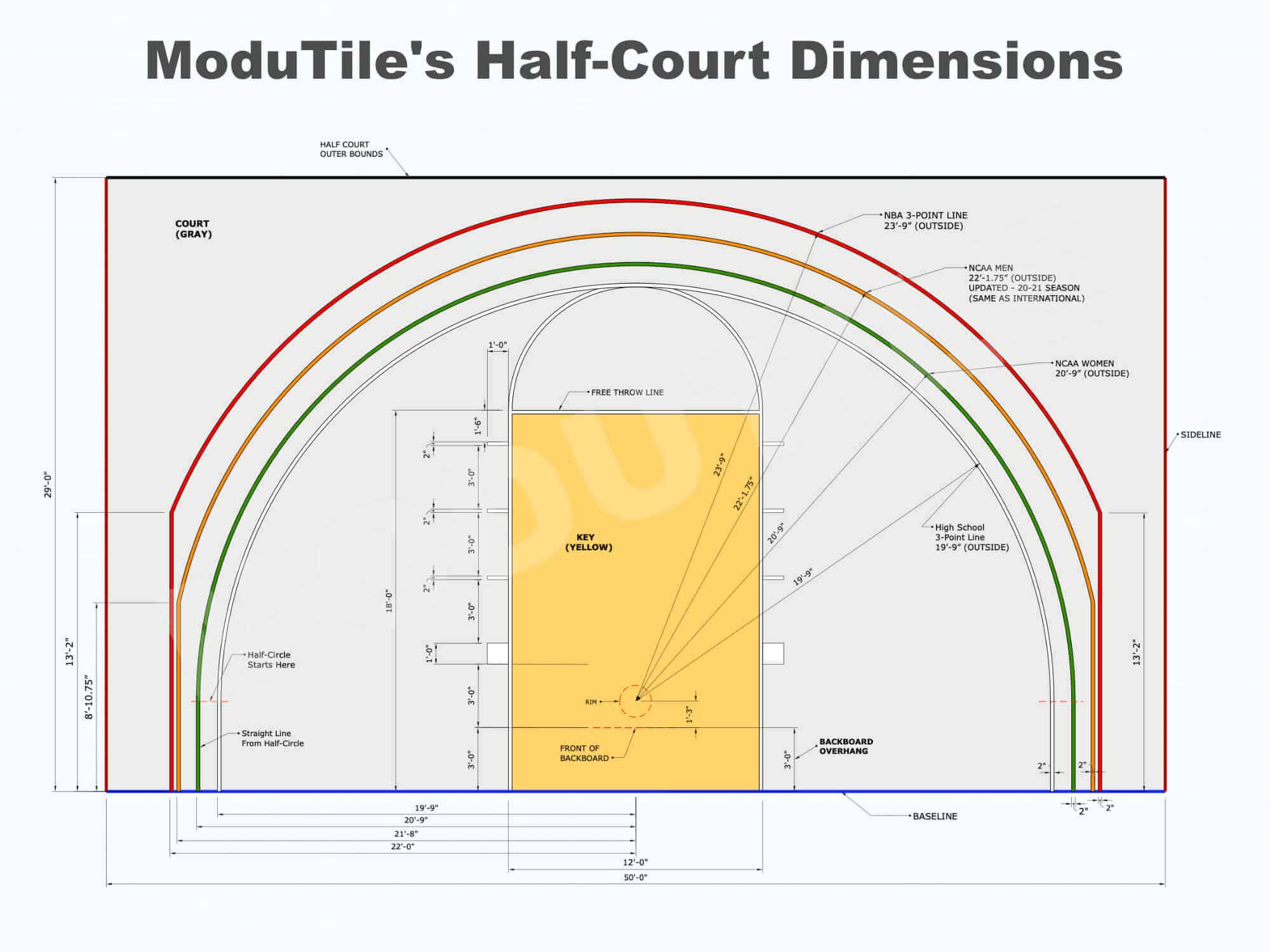
Image Source: modutile.com
The Fundamentals of Half Court Dimensions
At its core, a half basketball court is exactly what it sounds like: half of a full basketball court. This means it encompasses one basket, the associated free-throw line, and a portion of the playing area. The exact measurements, however, can differ based on the governing body, the age of the players, and the intended use of the court.
Regulation Half Court: The Standard
When we talk about a “regulation” half basketball court, we’re generally referring to the dimensions used in professional and collegiate basketball. These are the most commonly cited measurements and form the basis for many other court sizes.
Full Court vs. Half Court Ratio: A full NBA court is 94 feet long by 50 feet wide. Therefore, a regulation half basketball court is typically cut in half lengthwise, creating the 47-foot length. The width remains the same as the full court width.
- NBA Half Court: The NBA (National Basketball Association) uses a full court size of 94 feet by 50 feet. So, an NBA half court would measure 47 feet by 50 feet.
- FIBA Half Court: The International Basketball Federation (FIBA) uses a full court size of 28 meters (91 feet 10 inches) by 15 meters (49 feet 2.5 inches). A FIBA half court would therefore be 14 meters (45 feet 11 inches) by 15 meters (49 feet 2.5 inches).
It’s important to note that while the length is exactly half, the width often remains the full width of the court for practical reasons in divided facilities.
Standard Half Court Measurements
While the NBA and FIBA have specific standards, other leagues and organizations might adopt slightly different measurements for their standard half courts. These variations are often minor and don’t significantly alter the game’s dynamics.
- General Basketball Court Size: The general basketball court size for a full court is often cited as 84 feet by 50 feet for high school play. In this case, a standard half court would be 42 feet by 50 feet.
Half Court Area: Space for Play
The half court area provides the essential space for offensive and defensive maneuvers around a single basket. This includes the three-point line, the free-throw lane (the “paint”), and the space leading up to the half-court line.
Key Markings on a Half Court
A half basketball court includes several crucial markings that define the playing area and dictate rules.
- Free-Throw Line: This is located 15 feet from the face of the backboard.
- Three-Point Line: The distance of the three-point line varies:
- NBA: 23 feet 9 inches at the top of the arc, 22 feet in the corners.
- FIBA: 6.75 meters (22 feet 1.75 inches) at the top of the arc, 6.6 meters (21 feet 7.75 inches) in the corners.
- NCAA/High School: 20 feet 9 inches at the top of the arc, 19 feet 9 inches in the corners.
- Center Circle: The circle at mid-court, often used for jump balls or to mark the half-court line.
- Restricted Area Arc: The semi-circular area directly under the basket, designed to limit defensive charging fouls.
Youth Basketball Half Court: Growing the Game
For younger players, scaled-down courts are essential. A youth basketball half court is smaller to better suit the physical capabilities and skill development of children.
- Youth Basketball Half Court Dimensions: There isn’t one single universal dimension for a youth basketball half court, as it often depends on the specific league or age group. However, a common size for younger children (e.g., ages 6-8) might be around 30-35 feet long by 15-20 feet wide. As players get older, the court size gradually increases.
Adapting to Age and Skill
The purpose of a youth basketball half court is to make the game more accessible and enjoyable. Smaller courts mean:
- Shorter Distances: Players have less distance to dribble and shoot, which is crucial for developing coordination.
- Faster Pace: The game feels quicker and more engaging.
- More Shots: Players get more opportunities to shoot, which aids in skill development.
Common Youth Court Sizes:
- Under 10: Often use a half court around 35 feet long by 20 feet wide.
- Ages 10-12: Might transition to a court closer to 40 feet long by 22 feet wide.
Recreational Half Court: Casual Play and Practice
Recreational half courts are found in parks, driveways, and community centers. Their sizes can be highly variable, often dictated by available space.
- Recreational Half Court Flexibility: While a full court might be 94 feet long, a recreational half court could be significantly shorter, perhaps 30-40 feet long. The width might also be less than the regulation 50 feet, perhaps 20-30 feet wide, depending on the location.
Driveway Courts and Backyard Setups
Many people who want a half court at home are limited by their driveway or backyard size.
- Driveway Court Measurements: A typical driveway might accommodate a half court measuring 30 feet long by 15-20 feet wide. This is sufficient for practicing shooting and basic dribbling skills.
The Importance of the Hoop
Even with smaller dimensions, the presence of a regulation-height hoop (10 feet) is important for proper skill development, even on a recreational half court.
Fathoming Half Court Measurements: The Impact of Size
The size of a half basketball court directly influences the game played on it.
Playing Style and Strategy
- Smaller Courts: On a smaller half court, the game is often more about quick drives to the basket and close-range shots. Defenders have less space to cover, making it harder to get open. Passing lanes are tighter.
- Larger Courts: On a larger half court, there’s more room for dribble penetration, isolation plays, and the use of the three-point shot. Players have more space to create separation.
Equipment and Installation
When installing a new half court, you’ll need to consider the following:
- Surface: Asphalt, concrete, or specialized sport court tiles are common.
- Backboard and Hoop: Ensure the hoop is regulation height (10 feet) if you want to simulate official play.
- Markings: Durable paint or other materials are used to create the lines.
Considerations for Different Court Types
When discussing the size of a half basketball court, it’s helpful to consider the different contexts in which they are used.
Indoor vs. Outdoor Half Courts
- Indoor Courts: Often adhere more closely to regulation dimensions, especially in gymnasiums where multiple courts are marked on a single floor.
- Outdoor Courts: Can be more subject to space limitations, leading to more varied sizes in parks and driveways.
Multi-Purpose Courts
Some courts are designed for multiple sports. In these cases, the basketball markings might be smaller or adapted to fit within a larger playing area for soccer, tennis, or other activities. The full court to half court ratio can be a consideration here, ensuring that the half court segment is still functional for basketball.
Frequently Asked Questions (FAQ)
Q1: What are the official dimensions of a regulation half basketball court?
A1: For professional play like the NBA, a regulation half court is 47 feet long by 50 feet wide. FIBA courts are slightly smaller in length.
Q2: Can I set up a half court in my backyard?
A2: Yes, you can! Backyard half courts are often smaller than regulation size, typically around 30-40 feet long, depending on available space.
Q3: How does the size of a youth basketball half court differ from a regulation one?
A3: Youth half courts are smaller to accommodate younger players. Their length can range from 30 feet to 40 feet, with widths also being narrower than the regulation 50 feet.
Q4: Is the width of a half basketball court the same as a full court?
A4: Typically, yes. While the length is cut in half, the width of a half court usually remains the same as the full court width (50 feet for NBA, ~49 feet for FIBA).
Q5: What is the half court area?
A5: The half court area refers to the portion of the basketball court from the center line to one basket, including the free-throw line and three-point arc. Its specific measurements depend on whether it’s a regulation, youth, or recreational half court.
By grasping these dimensions, you can better appreciate the nuances of basketball and ensure you have the appropriate space for your needs, whether for competitive play or casual enjoyment.