
A standard basketball game is divided into four quarters.
Basketball is a sport played by two teams who try to score points by shooting a ball through a hoop. The game has a clear structure, and knowing how many quarters there are is a fundamental piece of information for any fan or player. This post will break down the basketball game structure, looking at how many quarters make up a standard basketball game and how that basketball period length can vary across different leagues and levels of play.
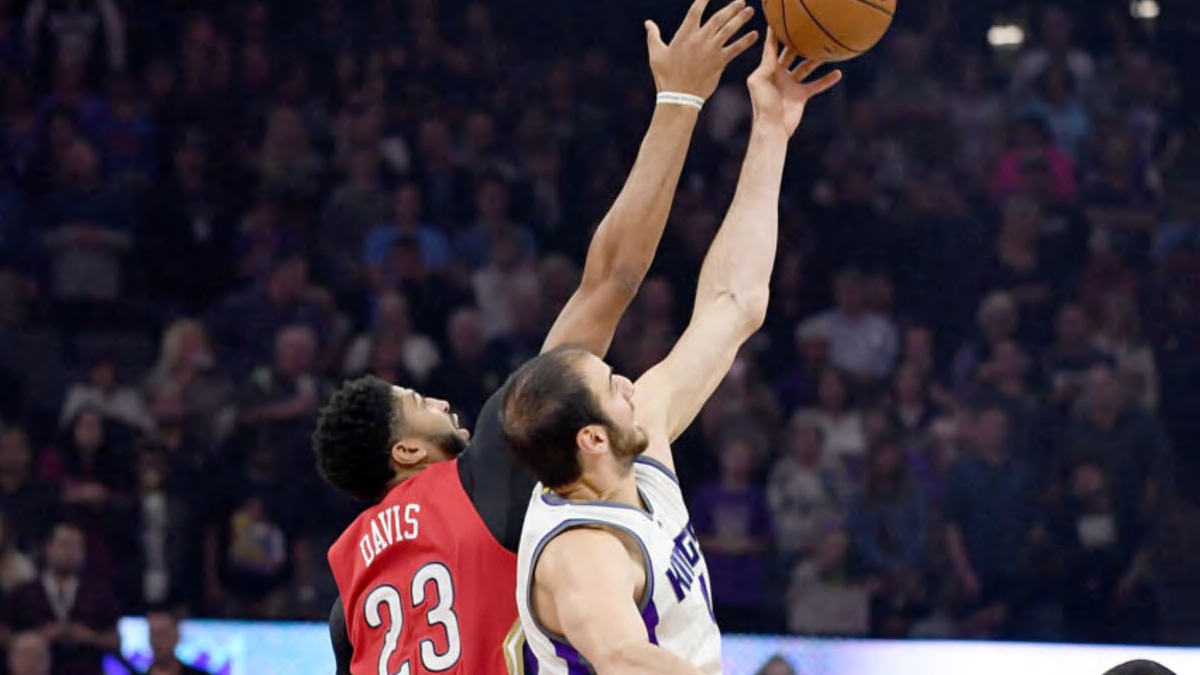
Image Source: images2.minutemediacdn.com
The Basic Basketball Game Structure
At its core, a basketball game is a timed competition. To manage this time and provide natural breaks, the game is divided into segments. These segments are known as quarters. Think of them as mini-games within the larger game. Each quarter has a set duration, and the teams switch sides of the court after the first and third quarters.
The Purpose of Quarters
Why divide a game into quarters? There are several practical reasons:
- Strategic Breaks: Quarters offer natural opportunities for coaches to talk to their players, make adjustments, and strategize. This is crucial for adapting to the opponent’s play and the flow of the game.
- Player Rest: Basketball is a physically demanding sport. The breaks between quarters allow players to rest, rehydrate, and recover their energy, helping to maintain a high level of play throughout the entire basketball game duration.
- Fan Engagement: Halftime, which occurs after the second quarter, provides a longer break for fans to grab refreshments, use restrooms, and enjoy entertainment. The shorter breaks between other quarters also offer moments for replays, analysis, and sponsor advertisements.
- Fairness: Dividing the game into equal periods helps ensure a fairer competition. No team gets a significant advantage by playing more or less of the game time in one go.
Quarter Lengths Across Different Leagues
While the concept of four quarters is universal in basketball, the actual length of each quarter can differ depending on the league or governing body. This variation is primarily seen between professional leagues, collegiate play, and youth levels. Let’s explore these differences.
NBA Quarter Length
The National Basketball Association (NBA) is the premier professional basketball league in the United States. A professional basketball game in the NBA is famously structured with NBA quarter length set at 12 minutes per quarter.
This means a regulation NBA game consists of a total of 48 minutes of playing time. However, due to the continuous clock stoppages for fouls, out-of-bounds plays, timeouts, and other reasons, the actual basketball game duration in the NBA is typically much longer, often around 2 to 2.5 hours.
Here’s a breakdown of the NBA game structure:
- Total Quarters: 4
- Length per Quarter: 12 minutes
- Regulation Playing Time: 48 minutes
WNBA Quarter Length
The Women’s National Basketball Association (WNBA) also follows a similar structure to the NBA, reflecting the high level of professional play. The WNBA quarter length is also 12 minutes per quarter.
This standardization between the NBA and WNBA helps create a consistent professional basketball experience for players, coaches, and fans alike.
- Total Quarters: 4
- Length per Quarter: 12 minutes
- Regulation Playing Time: 48 minutes
FIBA Quarter Length
For international basketball, the governing body is the International Basketball Federation (FIBA). FIBA rules are used in most major international tournaments, including the Olympics and the FIBA World Cup, as well as in many professional leagues outside of North America. The FIBA quarter length is slightly shorter than in the NBA and WNBA, with each quarter lasting 10 minutes.
This means a regulation FIBA basketball game has a total of 40 minutes of playing time. The shorter basketball period length can sometimes lead to faster-paced games with less time for strategic adjustments within each quarter.
Here’s the FIBA structure:
- Total Quarters: 4
- Length per Quarter: 10 minutes
- Regulation Playing Time: 40 minutes
College Basketball Quarter Length
In the United States, college basketball is governed by the National Collegiate Athletic Association (NCAA). Historically, college basketball was played in halves rather than quarters. However, the NCAA transitioned to a quarter-based system for women’s basketball in 2015 and for men’s basketball in 2019 to align more closely with international rules and to potentially improve game flow.
The college basketball quarter length is 10 minutes per quarter, mirroring the FIBA standard.
- Total Quarters: 4
- Length per Quarter: 10 minutes
- Regulation Playing Time: 40 minutes
It’s important to note that this change to quarters in college basketball was a significant shift from the traditional two 20-minute halves. The rationale behind this change was to introduce more intentional breaks for strategy and to enhance the game’s rhythm.
Youth Basketball Quarter Length
For younger players, the emphasis is often on skill development, participation, and shorter periods of intense focus. Therefore, youth basketball quarter length can vary significantly depending on the league, age group, and governing organization.
Common youth basketball quarter lengths include:
- 8-minute quarters: Often seen in younger age groups (e.g., 8-10 year olds).
- 10-minute quarters: Frequently used for older youth divisions (e.g., 11-14 year olds).
- 12-minute quarters: Some competitive youth leagues might adopt this length, similar to professional levels.
Many youth leagues also employ a “running clock” rule, where the clock only stops for fouls, out-of-bounds plays, or timeouts, rather than stopping every time the whistle blows, as is common in higher levels. This helps keep the overall basketball game duration manageable for young attention spans.
Overtime in Basketball
What happens if the score is tied at the end of regulation? In most basketball games, the competition isn’t over yet. If the score is tied after the four quarters have been played, an overtime period is added.
- NBA Overtime: If a game is tied after four 12-minute quarters, a 5-minute overtime period is played. If the score remains tied after the first overtime period, subsequent 5-minute overtime periods are played until a winner is determined.
- FIBA/College/WNBA Overtime: In leagues with 10-minute quarters (FIBA, WNBA, and NCAA), overtime periods are typically 5 minutes long. Similar to the NBA, if the score is still tied after the first overtime period, additional 5-minute periods are played until a winner emerges.
The addition of overtime periods extends the overall basketball game duration but is crucial for ensuring a definitive outcome in competitive matches.
Comparing Basketball Period Lengths
To summarize the variations in basketball period length across different levels, here’s a table:
| League/Level | Quarter Length (Minutes) | Total Regulation Time (Minutes) |
|---|---|---|
| NBA (Professional) | 12 | 48 |
| WNBA (Professional) | 12 | 48 |
| FIBA (International) | 10 | 40 |
| NCAA (College) | 10 | 40 |
| Youth Basketball (Varies) | 8-12 | 32-48 (depending on league) |
This table clearly illustrates how the structure of a standard basketball game can adapt to different contexts, from the intense pace of a professional basketball game to the developmental focus of youth leagues.
Why the Differences Matter
The variations in quarter length, particularly between the NBA and international/college play, can have subtle impacts on the game:
- Pace and Strategy: The extra two minutes per quarter in the NBA allow for more possessions and potentially more complex offensive and defensive sets. Coaches have slightly more time within each quarter to implement their game plans.
- Player Fatigue: While the total playing time is only 8 minutes different (48 vs. 40), the longer quarters in the NBA can concentrate fatigue differently.
- Game Flow: Some argue that the shorter 10-minute quarters in FIBA and college basketball lead to a more consistent intensity and fewer lulls in play.
The Evolution of Basketball Structure
It’s worth noting that the basketball game structure hasn’t always been this way. As mentioned, college basketball famously used halves for many decades before transitioning to quarters. This evolution reflects the sport’s ongoing development and efforts to improve its presentation and competitive balance.
The transition to quarters in college basketball was a significant change, impacting coaching strategies, player conditioning, and the overall rhythm of the game. The goal was to modernize the game and align it with international standards.
Frequently Asked Questions (FAQ)
How long is a quarter in the NBA?
An NBA quarter is 12 minutes long.
How long is a quarter in international basketball?
FIBA (international basketball) quarters are 10 minutes long.
Does college basketball have quarters?
Yes, NCAA college basketball now uses four 10-minute quarters, similar to FIBA rules. This is a change from their previous system of two 20-minute halves.
Are WNBA quarters the same length as NBA quarters?
Yes, both the WNBA and NBA have 12-minute quarters.
What happens if a basketball game is tied after four quarters?
If the score is tied at the end of regulation (four quarters), overtime periods are played until a winner is determined. The length of overtime periods varies by league, but is typically 5 minutes.
How many quarters are in a standard basketball game?
A standard basketball game is divided into four quarters.
What is the total playing time in an NBA game?
The total regulation playing time in an NBA game is 48 minutes (four 12-minute quarters). However, due to clock stoppages, the actual game duration is much longer.
What is the total playing time in a FIBA game?
The total regulation playing time in a FIBA game is 40 minutes (four 10-minute quarters).
Conclusion
In conclusion, the answer to “How many quarters are there in basketball?” is a consistent four quarters for a regulation game across most levels of play. However, the precise length of each quarter can differ, most notably between the 12-minute quarters of the NBA and WNBA, and the 10-minute quarters used in FIBA, college basketball, and often in youth leagues. This fundamental aspect of the basketball game structure shapes the pacing, strategy, and overall experience of watching and playing the sport. Whether it’s a professional basketball game or a local youth league, the division into quarters provides a familiar framework for the dynamic action on the court.