
A regulation basketball court, including the out-of-bounds areas, typically spans approximately 4,700 square feet. This figure can vary slightly depending on specific league rules and the inclusion of spectator areas, but it provides a solid estimate for the total footprint of a standard playing surface.
When thinking about basketball, the court is the most crucial element. It’s the canvas where plays are drawn, shots are taken, and games are won and lost. But have you ever stopped to wonder about the exact size of this vital space? How many square feet does a basketball court actually cover? The answer isn’t as simple as a single number because different organizations have slightly different rules. However, we can break down the standard basketball court area to give you a clear picture.
This blog post will dive deep into basketball court dimensions, exploring the specifics for various leagues and levels of play. We’ll cover everything from the NBA court size to FIBA court dimensions, and even look at high school basketball court size and college basketball court size. We’ll also touch upon indoor basketball court size and outdoor basketball court size, and even what constitutes a half basketball court dimensions.
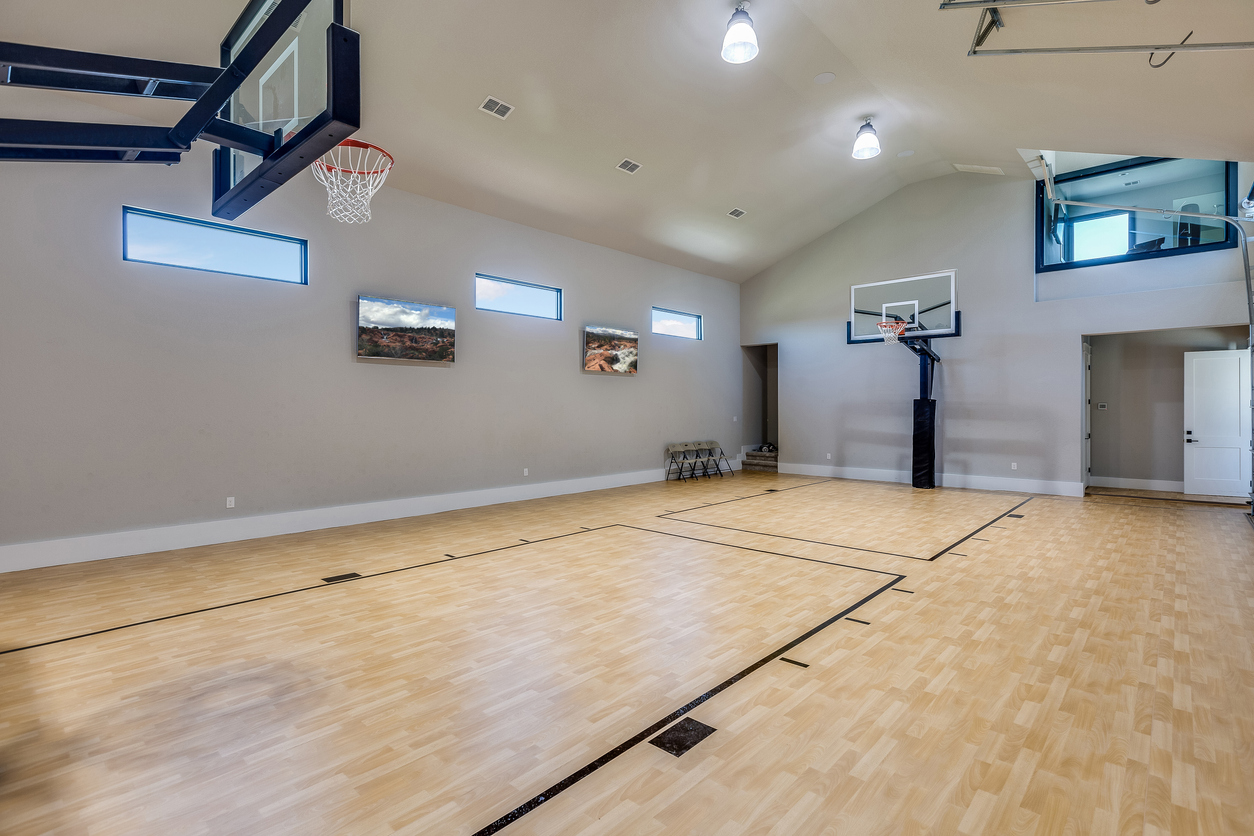
Image Source: www.dominatorhoop.com
Deciphering the Standard Basketball Court Area
The size of a basketball court is measured in length and width. These dimensions dictate the flow of the game, the strategy employed by teams, and the athleticism required from players. Having a consistent set of measurements ensures fair play and allows athletes to train and compete on a familiar playing field, regardless of location.
NBA Court Size: The Professional Standard
The National Basketball Association (NBA) plays on a court that measures 94 feet long and 50 feet wide. This gives us a total playing area of:
94 feet (length) * 50 feet (width) = 4,700 square feet
This is the NBA court size and is often considered the benchmark for professional basketball. These dimensions have been standard for many years, providing ample space for fast-paced action, dazzling dribbles, and powerful dunks. The court’s length allows for quick transitions from defense to offense, while its width provides enough room for players to maneuver and create scoring opportunities.
FIBA Court Dimensions: The International Perspective
The International Basketball Federation (FIBA) sets the rules for most international competitions, including the Olympics. Their court dimensions are slightly smaller than the NBA’s. A FIBA-regulated court measures 28 meters long by 15 meters wide. To convert this to feet:
- 28 meters * 3.28084 feet/meter = 91.86 feet (length)
- 15 meters * 3.28084 feet/meter = 49.21 feet (width)
Now, let’s calculate the total square footage for a FIBA court:
91.86 feet (length) * 49.21 feet (width) ≈ 4,522 square feet
While the difference might seem small, it can impact the game’s dynamics, especially in terms of spacing and the effectiveness of certain defensive strategies. The FIBA court dimensions create a slightly more compact playing environment.
Regulation Basketball Court: General Guidelines
When we talk about a regulation basketball court, we are generally referring to the dimensions set by the major governing bodies. While the NBA and FIBA have their specific measurements, there are often slight variations for other levels of play. However, the core principles remain the same: a rectangular playing surface with designated markings.
The key components of any basketball court include:
- Sidelines: The longer boundary lines.
- Endlines: The shorter boundary lines.
- Center Circle: Used for jump balls at the start of games or periods.
- Free Throw Lines: Where players shoot free throws after fouls.
- Three-Point Line: The arc that designates shots worth three points.
- Restricted Area Arc: The semi-circle under the basket that prevents defenders from camping out.
High School Basketball Court Size: Developing Talent
High school basketball courts generally follow the dimensions set by the National Federation of State High School Associations (NFHS). These dimensions are typically the same as the FIBA court:
91.86 feet long by 49.21 feet wide.
This means a high school basketball court size is approximately 4,522 square feet. This consistency allows young athletes to develop their skills on a court that mirrors international standards, preparing them for potential college or professional careers.
College Basketball Court Size: Bridging the Gap
College basketball in the United States, governed by the NCAA, typically uses the same dimensions as the NBA:
94 feet long by 50 feet wide.
Therefore, a college basketball court size is also around 4,700 square feet. This provides a professional-level playing experience for collegiate athletes, further honing their abilities in a familiar environment.
Indoor Basketball Court Size vs. Outdoor Basketball Court Size
When discussing indoor basketball court size and outdoor basketball court size, the fundamental dimensions usually remain consistent for regulation play. The primary difference often lies in the surface material and the environmental factors.
- Indoor Courts: Typically feature hardwood floors, providing optimal grip and bounce. They are protected from weather, ensuring consistent playing conditions.
- Outdoor Courts: Can be made of asphalt, concrete, or specialized rubberized surfaces. Weather conditions can significantly impact playability, with rain, wind, and direct sunlight affecting ball bounce and player movement.
While the playing area might be the same in square footage, the overall footprint of an indoor facility often includes spectator seating, locker rooms, and other amenities, making the total building size much larger.
Half Basketball Court Dimensions: Casual Play and Practice
A half basketball court dimensions refers to a court that is only half the length of a full court. This is common in parks, driveways, and recreational facilities for casual play or shooting practice. While there’s no strict regulation for half courts, they are typically around:
- 47 feet long by 50 feet wide (half of NBA length)
- 45.93 feet long by 49.21 feet wide (half of FIBA length)
The half basketball court dimensions provide a space for practicing skills like shooting, dribbling, and one-on-one play without the need for a full court.
Calculating the Total Area: The Math Behind the Court
Let’s summarize the key dimensions and areas in a clear, easy-to-read table.
| Governing Body | Length (feet) | Width (feet) | Area (sq ft) |
|---|---|---|---|
| NBA | 94 | 50 | 4,700 |
| FIBA | 91.86 | 49.21 | ~4,522 |
| High School (NFHS) | 91.86 | 49.21 | ~4,522 |
| College (NCAA) | 94 | 50 | 4,700 |
These numbers represent the playing surface itself. It’s important to note that most actual basketball facilities will have additional space beyond these dimensions for out-of-bounds areas, benches, and potentially seating.
Key Court Markings and Their Significance
Beyond the overall dimensions, the markings on a basketball court are crucial for the game’s structure and rules.
The Three-Point Line
The three-point line is perhaps the most dynamic marking on the court.
- NBA: The three-point line is 23 feet, 9 inches (7.24 meters) from the basket in the corners, extending to 22 feet (6.71 meters) at the wings.
- FIBA: The three-point line is 6.75 meters (22 feet, 1.75 inches) from the basket.
- NCAA/High School: The NCAA uses the FIBA three-point line distance. High schools typically align with FIBA or NCAA distances.
The placement of the three-point line significantly influences offensive strategy, encouraging outside shooting and spacing.
The Free Throw Line
The free throw line is a straight line 15 feet (4.57 meters) from the front of the backboard. A semicircle with a radius of 19 feet (5.79 meters) is drawn from the center of the free throw line. This area is crucial for free throw shooting and rebounds.
The Key (The “Paint”)
The area under the basket, often called “the paint” or “the key,” is a rectangle that extends from the baseline to the free throw line.
- NBA/NCAA: The key is 19 feet long and 16 feet wide at the top, tapering to 12 feet wide at the baseline.
- FIBA: The key is 4.9 meters (16 feet, 1 inch) long and 5.8 meters (19 feet) wide at the free throw line, tapering to 3.6 meters (11 feet, 10 inches) wide at the baseline.
The restrictions within the key, such as the 3-second rule for offensive players, dictate how teams attack the basket.
Why Do Court Sizes Differ?
The slight variations in court sizes between different leagues, particularly between the NBA and FIBA, stem from historical development and strategic considerations.
- NBA’s Larger Court: The wider and longer NBA court allows for more spacing, which caters to the athletic abilities of its players, emphasizing individual matchups and fast-break opportunities.
- FIBA’s More Compact Court: The slightly smaller FIBA court can lead to a more congested game, emphasizing team play, quick ball movement, and tactical execution. This can sometimes result in a higher tempo and more physical play.
These differences, while subtle, are intentional and contribute to the unique style of play seen in each league.
The Impact of Court Size on the Game
The dimensions of a basketball court have a tangible impact on how the game is played:
- Spacing: Larger courts offer more space, allowing offensive players to spread out, creating more isolation opportunities and driving lanes.
- Pace: The length of the court influences transition offense. Longer courts can favor teams with strong fast-break abilities.
- Defense: On smaller courts, defensive rotations need to be quicker, and help defense becomes more critical due to less space to cover.
- Player Fatigue: Covering more ground on a larger court can lead to increased player fatigue over the course of a game.
- Shooting Strategy: The distance of the three-point line can influence shot selection. A deeper line might encourage more shots closer to the basket, while a shorter line can open up more opportunities for long-range bombing.
Common Misconceptions About Court Size
One common misconception is that all basketball courts are the same size. As we’ve seen, this isn’t true. Another misconception is that the “square footage” only refers to the playing surface itself, without considering the surrounding out-of-bounds areas. However, for official measurements and overall facility planning, the entire designated playing area, including buffer zones, is considered.
Building Your Own Court: What You Need to Know
If you’re considering building your own basketball court, whether it’s a full-size regulation basketball court or a half basketball court dimensions for your backyard, knowing the official dimensions is essential. You’ll need to consider:
- Space: Ensure you have enough land for the court plus adequate run-off space around the perimeter.
- Surface: Choose a durable and appropriate surface like asphalt, concrete, or specialized recreational courts.
- Markings: Accurately paint all the lines, including boundaries, free-throw lines, and three-point arcs.
- Equipment: Install regulation hoops and backboards.
Remember, even a backyard court can be a fantastic way to enjoy the sport and improve your skills.
The Evolution of Court Dimensions
While current court sizes are well-established, the dimensions of basketball courts have evolved over time. Early basketball courts were often smaller and less standardized. As the sport gained popularity and athleticism increased, the dimensions were adjusted to create a more dynamic and exciting game. The standardization of court sizes by organizations like the NBA and FIBA has been crucial in the global growth and consistency of the sport.
Conclusion: A World of Hoops, Measured
So, how many square feet is a basketball court? For the most common professional and collegiate standards (NBA and NCAA), it’s approximately 4,700 square feet. For international and most high school play (FIBA and NFHS), it’s around 4,522 square feet. These dimensions, along with precise markings for lines, arcs, and circles, create the regulated playing field where the magic of basketball unfolds. Whether you’re a seasoned pro or a casual player, understanding these measurements helps appreciate the game’s nuances and the design behind every slam dunk and buzzer-beater. From the grand stages of the NBA to local parks with half courts, the dimensions of the court are fundamental to the sport we love.
Frequently Asked Questions (FAQ)
Q1: What is the exact square footage of an NBA basketball court?
A regulation NBA basketball court is 94 feet long and 50 feet wide, totaling 4,700 square feet.
Q2: Is a FIBA court the same size as an NBA court?
No, FIBA courts are slightly smaller. They measure 28 meters (approximately 91.86 feet) long by 15 meters (approximately 49.21 feet) wide, resulting in an area of about 4,522 square feet.
Q3: Are high school basketball courts the same size as college courts?
High school courts generally follow FIBA dimensions (91.86 ft x 49.21 ft), while college courts in the US typically follow NBA dimensions (94 ft x 50 ft).
Q4: Can I play basketball on any size court?
Yes, you can play basketball on courts of various sizes, but official games are played on courts with specific regulation dimensions. Half courts are common for practice and casual play.
Q5: What are the dimensions of a half basketball court?
There aren’t strict official regulations for half courts, but they are typically half the length of a full court, so roughly 47 feet long by 50 feet wide for an NBA-sized court.
Q6: Does the type of court (indoor vs. outdoor) affect its size?
The playing dimensions of an indoor basketball court size and an outdoor basketball court size are generally the same for regulation play. The differences are usually in the surface material and surrounding facilities.
Q7: How does the three-point line distance differ between the NBA and FIBA?
The NBA three-point line is deeper, measuring 23 feet, 9 inches at its deepest point, while the FIBA three-point line is 6.75 meters (approximately 22 feet, 1.75 inches).
Q8: What is the area of a regulation basketball court in square meters?
A regulation NBA court is approximately 436.64 square meters (94 ft * 50 ft * 0.092903 sq m/sq ft). A FIBA court is approximately 420.1 square meters (28 m * 15 m).